Research Elements
The research elements of this proposal are focused on the development of a general computational framework
to facilitate the close integration of measurements and models in CTMs. We are focusing our efforts on the
development of assimilation methodologies based on 4D-Var data assimilation and adjoint modeling to the
general and closely related problems of Adjoint Sensitivity Analysis, Optimal Variational Data Assimilation, and
Inverse Modeling. We are applying these techniques and analysis tools both to the interpretation of observational
data and to forecasting activities.
Theory
- Adjoint modeling
Adjoint model is one of the most effective ways to carry out the inverse problem.
It allows computing all the gradient components of the cost function that are necessary for optimization algorithm
at one time.
- Construction of discrete adjoints for stiff systems
Construction of adjoints can be obtained in two ways, i.e. discretizing the continuous adjoint model, and
building adjoints directly from the discrete forms of forward models. In order to have the adjoints
to be consistent with the prediciton models, they have to built based using the second way.
- Adaptive location of observations
The idea is to decide where to make observations that will maximally benefit resulting forcasts.
(Related papers: 1,
2 )
- Data assimilation for aerosol dynamics
It involves developing algorithms for adjoint implementation of data assimilation.
Numerical Algorithm
- New techniques for aerosol dynamics - basis for adjoint models
- Adjoint extension to Rosenbrock methods, and to stiff integrators in general
(Related paper)
- Implementation of transport algorithms in STEM
Software Tools
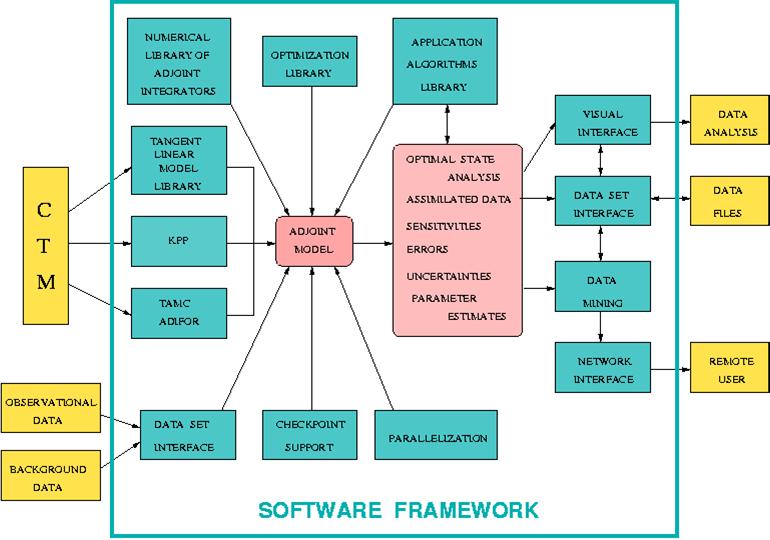
Software framework and tools to be developed
- TAMC (Tangent and Adjoint Model Compiler)
- KPP-1.2
(A tool to build adjoints for stiff chemical kinetics)
Both chemical transport models (CTMs) and their discrete adjoints are considered.
It can be used for second order information.
-
LBFGS
(A large-scale minimization method)
Block Truncated Newton
(Another large-scale optimization method good for parallel computers)
- PAQMSG
(A Parallelization Library for Air Quality Models on Structured Grids)
(Related paper)
Models
- STEM (Sulfate Transport Eulerian Model)
- CIT (California Institute of Technology Urban Air Shed Model)
- MOZART (Model for OZone And Related chemical Tracers)
- WRF (Weather Research and Forecasting Model)
Applications
- The analysis of data from Ace-Asia and TraceP experiments.
- Air quality forecasting. (Related report)
- The design of better observation strategies to improve chemical forecasting capabilities.
Example flight path of the NCAR C-130 flown to intercept a dust storm in East Asia that
was forecasted using chemical models as part of the NSF Ace-Asia (Aerosol Characterization Experiment in Asia)
Field Experiment
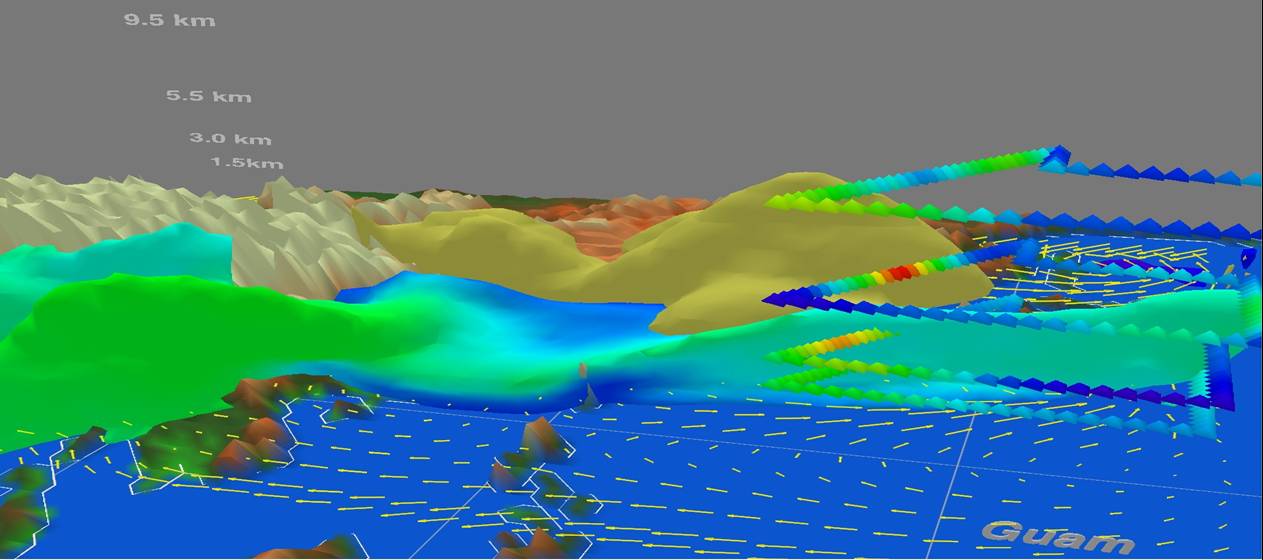
Shown are measured CO along the aircraft flight path,
the brown isosurface represents modeled dust (100 ug/m3), and the blue isosurface is CO (150 ppb)
shaded by the fraction due to biomass burning (green is more than 50%).
Data assimilation will help us better determine where and when
to fly and how to more effectively deploy our resources (People, Platforms, $s)
Related Studies/Links
- Inverse Modeling (Related paper)
-
Chemical Data Assimilation at ECMWF (European Centre for Medium-range Weather Forecasts)
-
Publications on TAMC (Tangent and Adjoint Model Compiler) Applications
- NASA Data Assimilation Office (DAO)
( Parallel computing)
-
Report on the First SPARC (Stratospheric Processes And their Role in Climate) Data Assimilation Workshop
- Mesoscale and microscale meteorology division of NCAR
( Chemistry, Aerosols, and Dynamics Interactions Research )
-
Investigation of Four-Dimensional Data Assimilation Methodologies for Air Quality Models (An EPA project)
-
TexAQS (Texas Air Quality Study) 2000 Aircraft Datasets Assimilation Based on Lagrangian Kalman Filtering Techniques
-
Data Assimilation at RIU/EURAD
(Rhenish Institute for Environmental Research/EURopean Air Pollution Dispersion model system)
-
Data Assimilation Initiative (DAI) at NCAR
Results
Revised: 9/2/03 by Tianfeng Chai